Cofounder conflict: the three stages, and what to do at each
You two, then a coach, then a mediator: the order matters.
Founders love talking about their failures. The product that never found its market, the pivot that flopped: it makes a great conference talk, and an even better LinkedIn post. Their fights with their cofounder? Not so much. Those stay private, and everyone waits for them to blow over.
Anyone who's watched friends go through a breakup knows how it goes, though. It starts with an argument nobody finishes, then another one. One day there's no arguing at all: each of them just does their own thing, and mutual friends start picking sides. Cofounders go down the same way, with a founders' agreement instead of a marriage license.
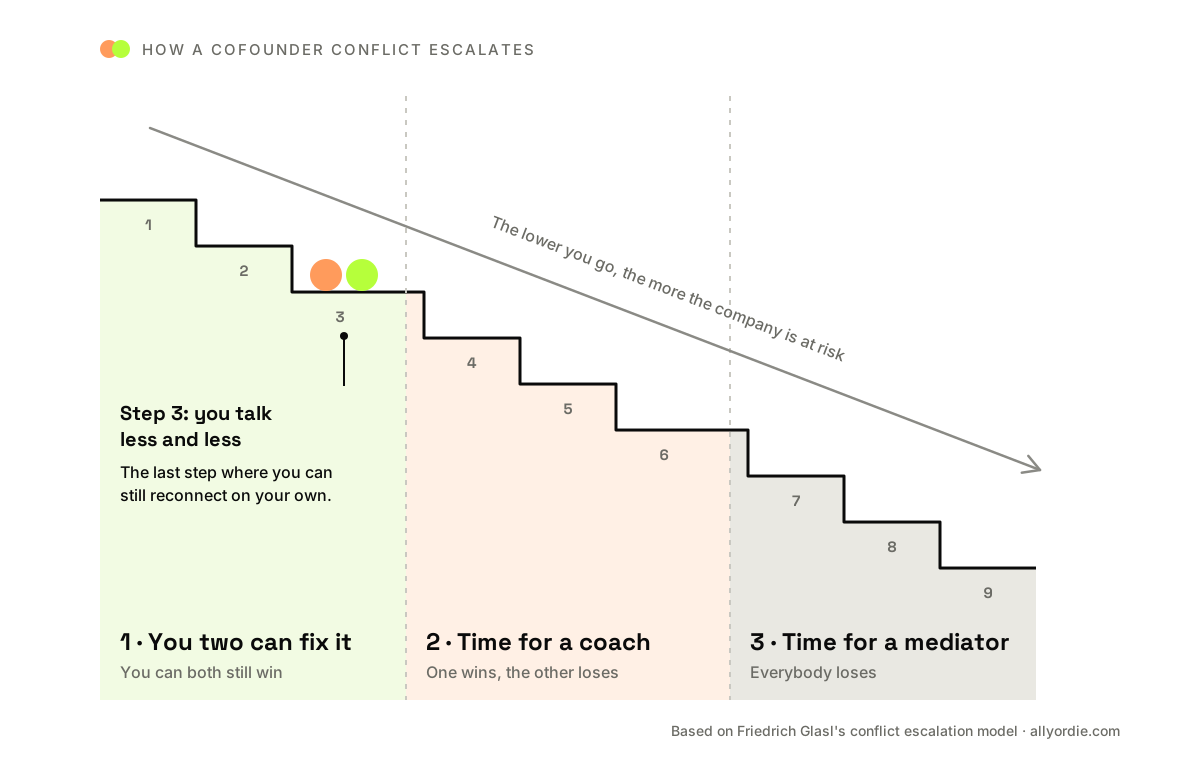
In the cofounder teams we work with, it plays out in three stages. In the first, you can still sort it out between the two of you. In the second, you need someone from the outside, like a cofounder coach, and one of you may end up leaving. In the third, you've stopped talking: it takes a mediator, sometimes lawyers, and the company itself is on the line. The real danger is missing the first stage, and that's easy to do when only one of you sees it coming.
A staircase that only goes down
These three stages line up with the conflict escalation model of Friedrich Glasl, an Austrian researcher whose work is a staple for mediators. Glasl describes conflict as a staircase with nine steps, and it goes down: every step takes you a little deeper, often without you noticing, and it gets harder to climb back on your own.
The nine steps fall into three stages. On the first three, both sides can still come out ahead. On the next three, one side's win is the other's loss. On the last three, everybody loses. It's a practitioner's rule of thumb rather than a scientific scale, but it gets the main thing right: step three, the last one of the first stage, is where it all plays out, when you talk less and less and start acting on your own.
The first steps don't make a sound
At first, nothing breaks. You disagree about a hire or about the pace, and that's a good sign: a study of more than 300 new ventures found that disagreements about the work improve results. Personal conflict hurts them, and the first kind tends to turn into the second.
That shift is what to watch for. The day what bugs you is less the issue than the way they talk to you, you've started going down. Then the complaints get broader (“you never listen”), every discussion turns into something to win, and each of you starts pulling in someone from the team or the board.
The clearest signal is contempt. Psychologist John Gottman, who studies couples, calls it the strongest predictor of divorce. Nobody has measured it in cofounders, but an eye roll in the middle of a meeting doesn't need much translating.
When only one of you feels it
Often you both sense the friction, but one of you lives with it a lot more easily. Research on this shows that the gap alone hurts a team, and that whoever feels the tension more has a hard time getting heard.
That person ends up stuck between keeping quiet to avoid making waves and dumping everything at once. Both take you further down: silence lets the other one make the calls alone, and the big talk comes out of nowhere for someone who thought things were fine.
It's also when you're the most alone, because asking your cofounder to talk about it already feels like an admission. Several founders whose companies ended over a cofounder conflict told us the same thing in recent weeks: the tool they were missing is one you use on your own. Before you try to convince the other person, check that they see what you see.
Money speeds up the fall
Money is one of the three big things cofounders fight about, along with how you work and where you're headed, but it's the one that drags you down the fastest. With equity, whether the split feels fair matters more than the split itself.
Researchers at the Technical University of Munich who followed founding teams up close saw it firsthand: a split that felt fair set off a virtuous circle, one that felt unfair a vicious one. A 70/30 split that reflects what each person brings can sit just fine, while a 50/50 starts to grate the day one of you feels like they're carrying the company.
They also watched teams that started strong split apart when investors sided with some of the founders. An investor who picks a side pushes everyone down to the next stage.
What you can still do, stage by stage
In the first stage, while you're still talking, this is the time to bring up the touchy stuff, precisely because the tension is still low. Start with a question, one on one: “I feel like we're making fewer calls together lately. Are you seeing that too?” Talk about facts and needs, never about character. And if you're each already deciding things on your own, take an hour to write down who decides what: the disagreement shifts from the person to the rule.
In the second stage, stop looking for allies on the team and suggest bringing in a third party, picked together, to help you both. If you need to vent first, do it with someone outside the company who'll listen without judging.
In the third, protect the company and protect yourself: talk to a lawyer before you make any move, and put nothing in writing while you're angry. Mediation is still on the table, and it works more often than people think: at CMAP, the Paris center for mediation and arbitration, six in ten mediations end in an agreement, across all kinds of disputes.
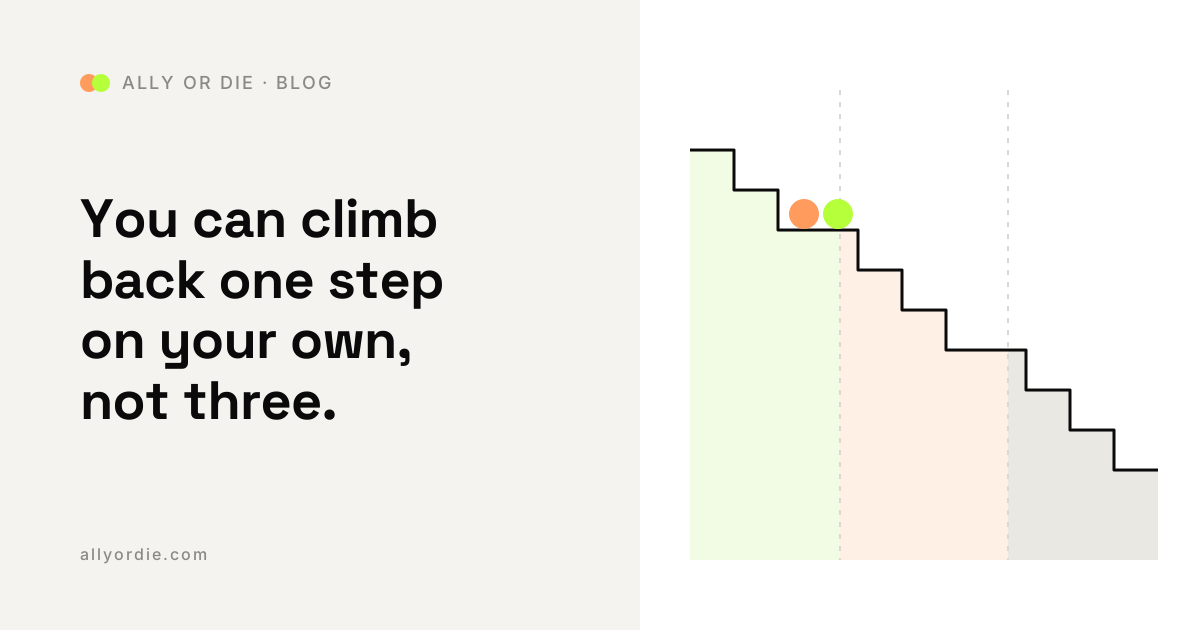
You can climb back one step, not three
In a couple, a fight gets patched up the next morning, over coffee and a clumsy apology. Three months of silence later, you need a therapist, and sometimes a lawyer to split the furniture. With cofounders, the furniture is your customers, your team, and your equity. The hardest part is spotting the first step, when nothing's broken yet and you're afraid you're overreacting. That's exactly when one question is enough. Start with the two of you, while you still can.
Try this solo, then with your cofounder
10 min“What decision have you made in the past few weeks without running it by your cofounder, just to avoid the conversation?”
That's the sign of step three.
- 1Write it down on your own, without judging yourself.
- 2When you're ready, ask your cofounder just one question: “Do you feel the same tension I do?”
- 3Listen to the answer without correcting it.
Sources
- Friedrich Glasl's model of conflict escalation (Wikipedia)
- Friedrich Glasl, Nine Stages Down, Das Goetheanum (2022)
- De Jong, Song & Song, How Lead Founder Personality Affects New Venture Performance, Journal of Management (2013)
- Forbes, Managing Conflict in New Ventures (2015)
- Maiese, Escalation, Beyond Intractability (2003), based on Pruitt & Rubin
- The Gottman Institute, Research FAQ
- Jehn, Rispens & Thatcher, The effects of conflict asymmetry on work group and individual outcomes, Academy of Management Journal (2010)
- University of Groningen, High task conflict perceivers (on Jehn et al.)
- Kozusznik & Euwema, Conflict Issues in Start-up Co-founders, Negotiation and Conflict Management Research (2025)
- Breugst, Patzelt & Rathgeber, How should we divide the pie?, Journal of Business Venturing (2015)
- TUM School of Management, Dividing the pie (summary)
- CMAP, 2025 Mediation Barometer (in French)