There's no such thing as the perfect cofounder
Being alike won't save you. Neither will being opposites.
When a founder introduces me to the person they want to start a company with, they almost always lead with what they have in common. We share the same values, we see things the same way, we don't even need to talk to understand each other. Or the exact opposite, with exactly the same enthusiasm: they're everything I'm not, we complement each other perfectly.
Either way, I ask the same question, and it throws people every time: what are you two going to clash over?
Not whether. What. Because in a year of working closely with about ten cofounder pairs, I haven't seen a single one get a pass.
The dream match that slowly fell apart
I'm thinking of one pair who checked every box. Same values, same way of seeing things, same hobbies, two calm, even-keeled personalities. When they talked about each other, it was with the quiet certainty of people who feel they've found their match. On paper, perfect alignment.
Their first real disagreement came with their first hire, over what kind of profile to bring on. A garden-variety disagreement, on the surface. And the two calm ones dug in. Each held their ground, and neither knew how to restart the conversation. They didn't know how to disagree together, for the simple reason that they never had.
That hire isn't what split them up. It was the first brick. Every friction after that got stacked on top of it, never really resolved, until the whole thing gave way.
What they'd vetted at the start was comfort. Being alike makes the early days easy. It tells you nothing about how you'll get through a conflict. Two calm people can just as easily be two people who avoid, and who find out, on the day it matters, that they never learned how to say no to each other.
The unlikely pair that made it work
At the exact opposite end, I knew a pair who didn't particularly like each other. No friendship, not much in common, working styles that flat-out clashed. A fit test taken over their first coffee would probably have told them not to team up.
And yet they found a way to make it work. As they discovered their friction points, they set rules. First, a signal: an emoji they'd agreed on in Slack that meant “heads up, this is getting heated, you're touching something that's going to set me off.” No arguing, no justifying, just pulling the alarm before it blew up. Then, a protocol for when the alarm goes off: let it cool down, and come back with solutions, not accusations.
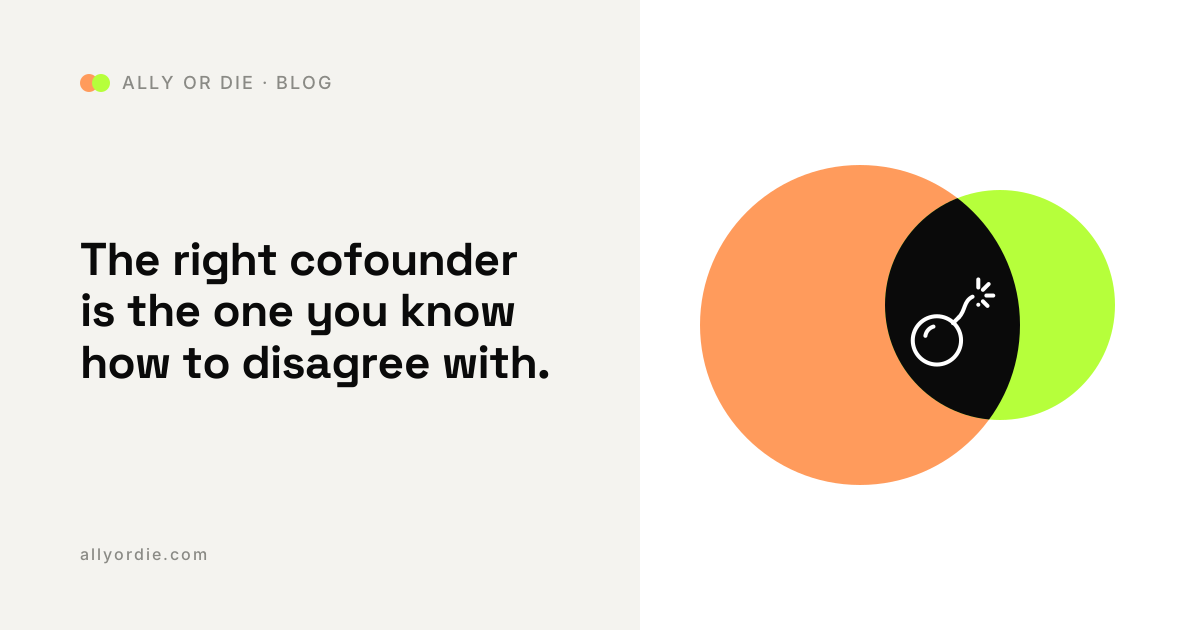
They had their own emoji. At Ally or Die, we recommend 💣. It's the symbol we use for triggers, the topics where the other person presses right on the spot that hurts. Just having it handy means admitting there's a mine in the field.
What the pairs who last actually do
I've seen the same mechanics, in other forms, with other cofounders who didn't have much in common.
Some eventually agreed, usually over a debrief dinner rather than at an offsite, that on sensitive topics you pick up the phone instead of typing. A message leaves all the room in the world for interpretation, and when you're on edge, you always read the worst into it. They'd also banned themselves from assuming intent: when something stings, you assume it wasn't meant that way, and you say so.
Others, two people who got heated fast on the big questions, sometimes in front of their teams, stuck to one very simple rule. When it flares up, you acknowledge that you disagree and stop there. But you come back to it once you've both cooled off, and that part was non-negotiable. Nothing swept under the rug.
None of these pairs made their friction go away. They gave themselves a way to see it coming, a way to bring the temperature down, and an obligation to come back to it. A signal without the follow-up is just polite avoidance. The follow-up without the signal is a blowup every time.
Your opposite isn't your complement
This is where the usual playbook gets it wrong. We look for someone like us, so things stay easy, or someone who's our opposite, so we feel complete. Along the way, we mix up two very different things: complementary skills, which is a good idea, and complementary personalities, which isn't necessarily one. The opposite energy that wins you over at the first coffee is often the one that wears you out day to day. And the sameness that feels reassuring at first can hide two identical blind spots.
There's no perfect cofounder. The right one is the one where you know exactly where you'll clash, and how to defuse it.
So the right question isn't “are we alike?” or “do we complement each other?” It's “can we disagree without losing each other?”
Find your friction points before they cost you
Every one of these pairs, including the ones who made it, has one thing in common: they found their friction points as they went, each one paid for with a crisis. That can work, as long as you have the time, the energy, and a company sturdy enough to absorb the lessons.
You can also look at them up front. That's what The Duo does: you each answer on your own, and the Duo Report cross-references your two profiles to show where you'll clash, with ways to defuse each one. No compatibility score, no verdict on the other person. Just what you need to set your own ground rules before you need them, rather than after the first blowup.
Start with you
About ten minutes to find out what kind of cofounder you are, and the profile that complements you.
Start with The Mirror