Every cofounder plays Monopoly by their own rules
Your founders' agreement covers the breakup, not the Tuesday night fight.
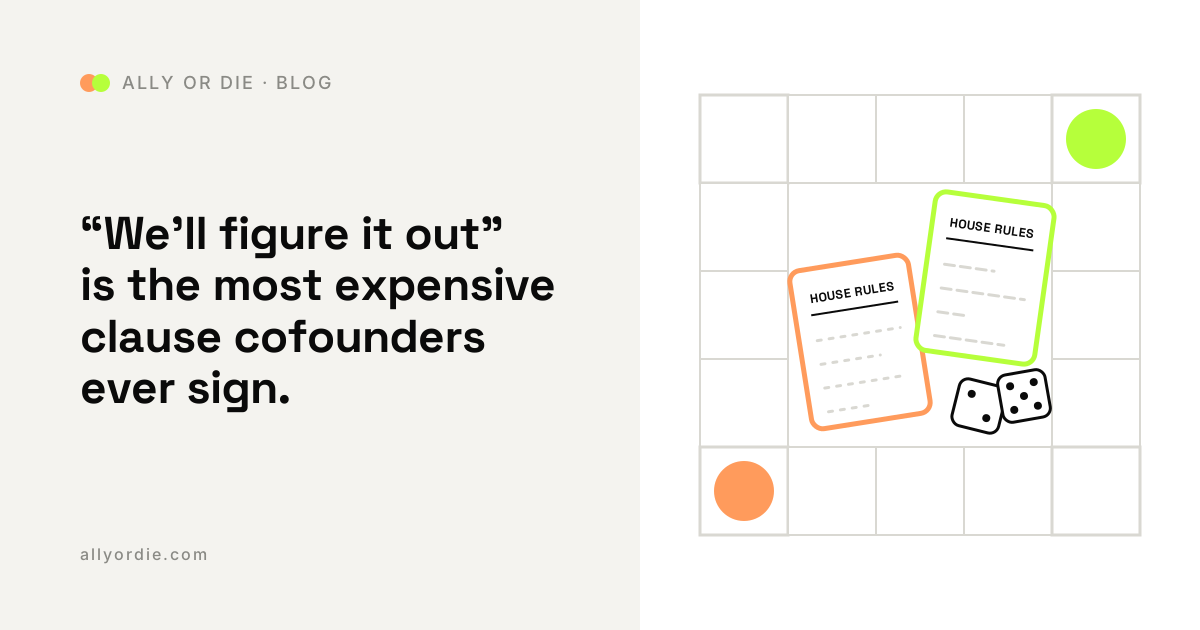
Every family plays Monopoly by its own rules. In some houses, fines pile up in the middle of the board and whoever lands on Free Parking takes the pot. In others, you collect $400 if you land right on Go (or so I had my brother convinced for our entire childhood). Nobody ever checked, since everyone at the table agrees. You only find out those aren't the rules the day you play at someone else's house, and the game turns into a showdown over a stack of Monopoly money.
Two cofounders are two families sitting down at the same table, each with its own house rules about money, time and decisions. Each is genuinely convinced they're playing the same game. And for a long time, it works.
In the partnerships we work with, the ones that crack rarely break over what's in the founders' agreement. They break over what was never written down anywhere.
“We'll figure it out”: the clause everyone signs
“We make the big calls together.” “We're both all in.” “We'll pay ourselves once we raise.” These lines get said once, usually over a beer, met with a nod, and filed under settled.
Nobody's lying when they say them. They're just vague. Is a big call a hire, a customer, a price? Does “all in” mean sixty-hour weeks, or picking up the phone on Sunday? Nobody asks, because asking would feel like you don't trust the other person.
All of these deals boil down to four words: “we'll figure it out.” It's probably the most expensive clause cofounders ever agree to, and nobody ever wrote it down.
Until somebody lands on the wrong square
Two cofounders start a company. One is coming off ten years at a big company, with solid savings and a severance package. The other has six months of runway if they're careful. The rule falls into place on its own: we'll pay ourselves once we raise. The round is supposed to close in nine months.
It closes in eighteen. After a year, the second cofounder says they're taking on freelance work two days a week, just to get by. It won't change anything, they promise, they'll make up for it nights and weekends. Their cofounder says yes. What else are you going to say?
On paper, it works. In reality, replies come slower, meetings slip, and the exhaustion shows. The first cofounder starts thinking their partner isn't all in anymore. The second feels like they're carrying two jobs and nobody notices.
By the time it comes out, it isn't about money anymore. “You've checked out.” “You never once asked how I was making rent.” Two sets of house rules colliding, and both cofounders acting in good faith.
And nobody read the rulebook
If these deals are so fragile, why does nobody write them down? We hear the same reasons every time.
First, the fear of killing the momentum. Pulling out a document to spell out who pays for what is a bit like bringing a spreadsheet on a first date.
Then the classic: “we know each other.” Often true, and that's exactly the trap: your cofounder's rules look so much like yours that you can't see where they split.
Less flattering: writing forces you to decide. As long as it's “we'll figure it out,” each of you keeps your own version of the deal.
And the only document the startup world pushes you to draft is the founders' agreement. So you assume you're covered.
Two pages to write before you roll the dice
In the duos that last, we keep finding two documents. They're rarely formalized as such, but they're there.
The first one is about each of you: how I work, what I need to do my best work, who I become under pressure, how to tell me something hard, and how I cool off outside of work. It's the user manual for the person you're about to spend more time with than your spouse.
The second one is about the two of you and the friction you already see coming: money if your situations are different, time if one of you has something else going on, visibility if one of you loves the spotlight and the other doesn't. For each one: the signal that tells you you're there, what each of you will do when it happens, and when you'll revisit it.Every “we'll figure it out” gets a date.
That second document isn't a legal thing. It's a handshake deal you actually wrote down, a page you pull out the day things get tense. Some cofounder coaches even call these “cofounder vows” and have their clients renew them every quarter.
Research points the same way. A 2026 study out of IÉSEG School of Management found that cofounders rarely walk away over a disagreement about the work itself, and far more often over the resentment it leaves behind when nobody deals with it. So it pays to decide how you'll handle disagreements while you still get along.
Your founders' agreement is for the divorce
None of this replaces the founders' agreement. If a partnership is an arranged marriage where the baby, the company, shows up right away, the founders' agreement is the prenup: essential, and built for the day you split. Who keeps what, who walks away with how much, how you get out.
But marriages rarely fall apart in a lawyer's office. They fall apart on a Tuesday night, in a fight about what time you're getting home, when the real issue was something else entirely. Your founders' agreement says nothing about Tuesday night: not about the cofounder who drops to three days a week, not about the call made without the other. All you've got is what you told each other beforehand.
The ones who read the rulebook fight better
House rules are nothing to be ashamed of. They're often what makes the game fun. What hurts a partnership is discovering your cofounder's at the exact moment they cost you.
Taking an hour to write them down means asking a less romantic question than “are we going to make it?”: what game are we actually playing? Cofounders who've done it don't fight less. They fight about the right things, and they know how to find their way back.
Try this together
10 min“What's one rule you think you and your cofounder share, but have never said out loud?”
Money, time, decisions, or who gets the credit.
- 1Each of you writes down your rule separately, no comparing notes, plus what you'd suggest doing the day it stops holding.
- 2Swap.
- 3Same rule? Great. Different ones? You just found your first “we'll figure it out.”