The Cofounder Cycle: the five stages of a partnership that lasts
A partnership isn't decided once. It's built, tested and kept up.
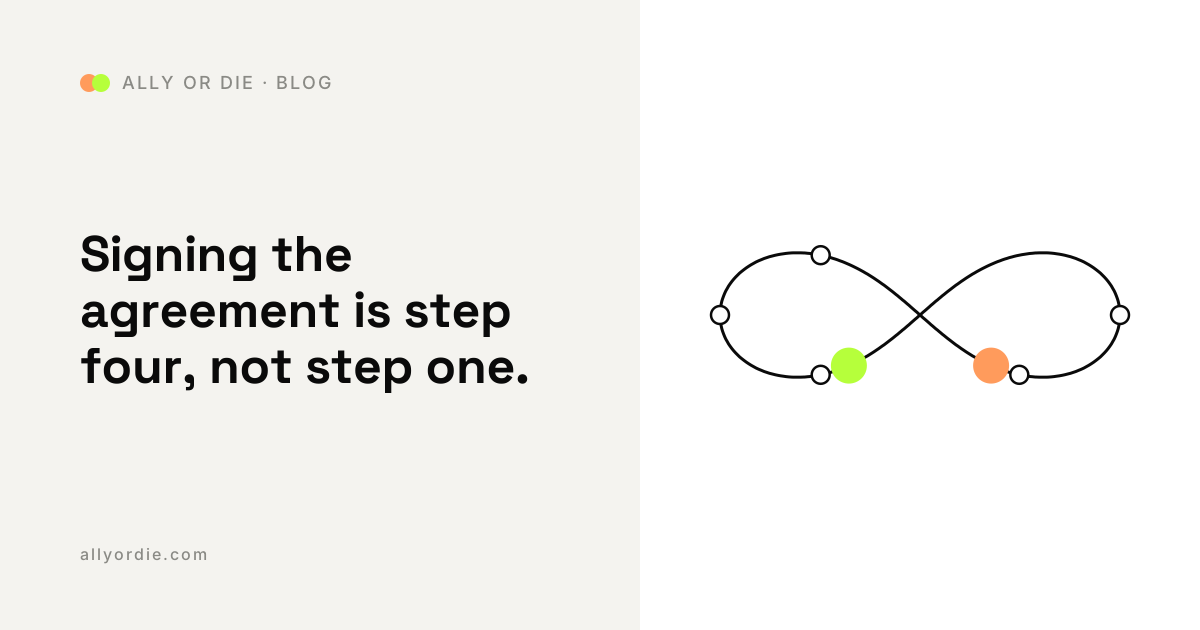
We talk about a partnership as if it were a moment. The day you decide to build the company together, the day you sign the founders' agreement, the day you split the equity. As if, once that's behind you, the question is settled and all that's left is the work.
What I see with the founders I work with tells a different story. A partnership isn't decided once. It's built before, formalized during, and maintained long after. Existing tools each cover a piece of that story: matching platforms handle the meeting, legal tech handles the paperwork. The rest, which is to say almost everything, has neither a name nor a method.
That rest is what we set out to structure. We call it the Cofounder Cycle. Five stages, in an order that matters, because most partnerships that break skipped one of them without realizing it.
Where the cycle comes from
It didn't come out of a sticky-note workshop. It took shape over about ten partnerships I worked with closely this past year, from watching the same breakups replay in the same places, and it builds on what research already says. Noam Wasserman's work at Harvard showed how heavily tension between founders weighs on startup failure. Work by McCarthy and colleagues on founder personality feeds into our first stage. The cycle connects the two: what research observes at scale, and what the field shows up close, right when it's happening.
For each stage, we kept two things: the question it needs to answer, and the signal that tells you you've really cleared it.
Know yourself
It all starts with you, and it's the stage almost everyone skips. You go looking for a cofounder with a fairly precise idea of what you expect from them, and a very fuzzy idea of what you actually bring. How you handle risk, money, and conflict, how you make decisions under pressure, what you're willing to sacrifice for the company and what you never will. Until you've answered that for yourself, you can't know who complements you. You only know who you like.
The question: what do I really bring, and what will I never compromise on?
The signal: you can describe how you handle risk, money, and conflict in a few sentences, without mentioning your future cofounder once.
Choose each other
Then comes the search. It's the best-documented part, and yet it's where the costliest misunderstanding hides: believing there's someone out there who complements you in every way. A sales profile and a product profile complement each other on paper. Two people, one who charges ahead and one who needs to validate everything, can wear each other out in six months. A big difference in energy is attractive over a first coffee. That doesn't prove you'll work well together.
There's no perfect cofounder. The right one is the one where you know exactly where you'll clash, and how to defuse it. So once the chemistry is there, that's exactly the moment to ask the hard questions, with a cool head, while there's nothing to protect yet: your five-year vision, each person's real commitment, what happens if one of you wants to sell and the other doesn't, what you do when you disagree.
The question: where are we going to clash, and do we know before we've started?
The signal: you can name your friction points, not just what's going to work. And at least one of those conversations made you uncomfortable. If everything went smoothly, you didn't dig deep enough.
Test the fit
Conversations aren't enough. You can be completely sincere over coffee and discover a whole different way of operating the day something has to ship. Testing the fit means giving yourselves a set period, a few weeks to a few months, where you actually work together on a real problem, under real constraints, with the explicit option to stop without drama. It's fail fast, applied to the relationship. It's scary because it could end something you want to see work. That's exactly why it's useful.
The question: can we get through a disagreement under pressure, when things really grind?
The signal: you've had at least one real disagreement, and you worked it out without either of you checking out.
Commit
Only now do you sign. The founders' agreement, the equity split, governance, exit terms. This stage often gets handled first, because it's the most concrete and the most reassuring. But a founders' agreement protects the exit, not the relationship. Signed too early, it locks in a deal between two people who don't yet know how they work together. Signed at the right time, it turns what the earlier stages taught you into legal terms.
The question: does the paperwork reflect what we've learned about each other?
The signal: every major clause in your agreement maps to a conversation you actually had.
Go the distance
Then the company lives, and the partnership with it. Going the distance isn't a stage you clear. It's a state you maintain. Roles shift, pressure builds, each person's life changes, and what was aligned at the start stops being aligned without anyone deciding it. Most partnerships don't die in one big blowup. They wear down under a pile of little things nobody said.
The question: are we still telling each other things?
The signal: disagreements come up early, while they're still small, not as a crisis.
Going the distance doesn't mean no more friction. It will come, and that's normal: it's exactly why you named it beforehand. What keeps a partnership going is defusing friction the moment it shows up, not three months later as a crisis. And when that's no longer enough, there are two ways out. You can take the time to put everything back on the table, which often leaves the partnership stronger than before. Or you can split up. That isn't always a failure. A well-handled split beats a partnership that limps along hurting everyone, the company included.
Why a cycle, not a checklist
Because the order matters as much as the content. Signing before you've tested the fit, or searching before you've taken a hard look at yourself, is pouring a foundation on ground you've never surveyed. And because Go the distance keeps sending you back to the earlier stages: a partnership in crisis often needs to go back to stage one, each person on their own, to understand what changed.
Every article on this blog ties back to one of these stages. And Ally or Die's tools follow the same path, starting with the first: The Mirror, a few-minute test to find out what kind of cofounder you are, and where your friction points will be.
Start with you
About ten minutes to find out what kind of cofounder you are, and the profile that complements you.
Take the test